


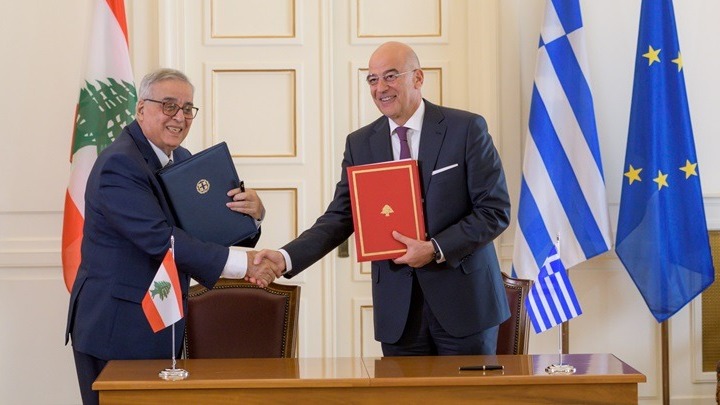
Visiting Lebanese Foreign Affairs Minister Abdallah Bou Habib expressed his country’s commitment to continuing its historic ties with Greece and improving bilateral relations, after meeting his counterpart Nikos Dendias in Athens on Friday.
Referring to the trilateral meetings with Cyprus, the Lebanese FM said at a press conference that he looked forward to more meetings with Greece and Cyprus, and highlighted the geographic proximity of his country with Greece. In terms of Cyprus, he said a negotiation had begun on an amendment to an agreement on maritime boundaries signed in 2007, and noted that “we agreed in principle and must now write the text, to legalize the new agreement; we also have the issue of Syria for the borders, and perhaps Cyprus and Greece could participate.”
In terms of Lebanon’s agreement with Israel on the delimitation of maritime zones, Habib said that it was signed despite the fact the two countries do not have formal diplomatic relations. “Our relations move through the United Nations system,” he noted, and said the United States’ mediation efforts had been successful. He expressed the hope that as soon as the new government is in place in Israel efforts start to resolve the differences with the land borders between the two countries.
The Lebanese minister condemned Russia’s invasion of Ukraine, “despite being friends with Russia.” As he said, “We are a small country and we support International Law and expect it to be a fundamental principle for the relations between countries, and dialog must be the basic principle underpinning relations between countries.” He also expressed his regret over “what Russia did to Ukraine” but noted that Lebanon does not support Russia’s isolation, within its membership in the UN.
The visiting FM spoke extensively of the refugee issue in Lebanon, with 2 million Syrian refugees in a country of 4 million and nearly 1 million Lebanese in the diaspora. His country subsidizes basic goods like bread, he said, 40% of which is consumed by Syrian refugees. Living in Lebanon for the last 11 years since the war started in their country, they depend on funding from the UN’s High Commission for Refugees and from the European Union to remain in Lebanon, he said.