



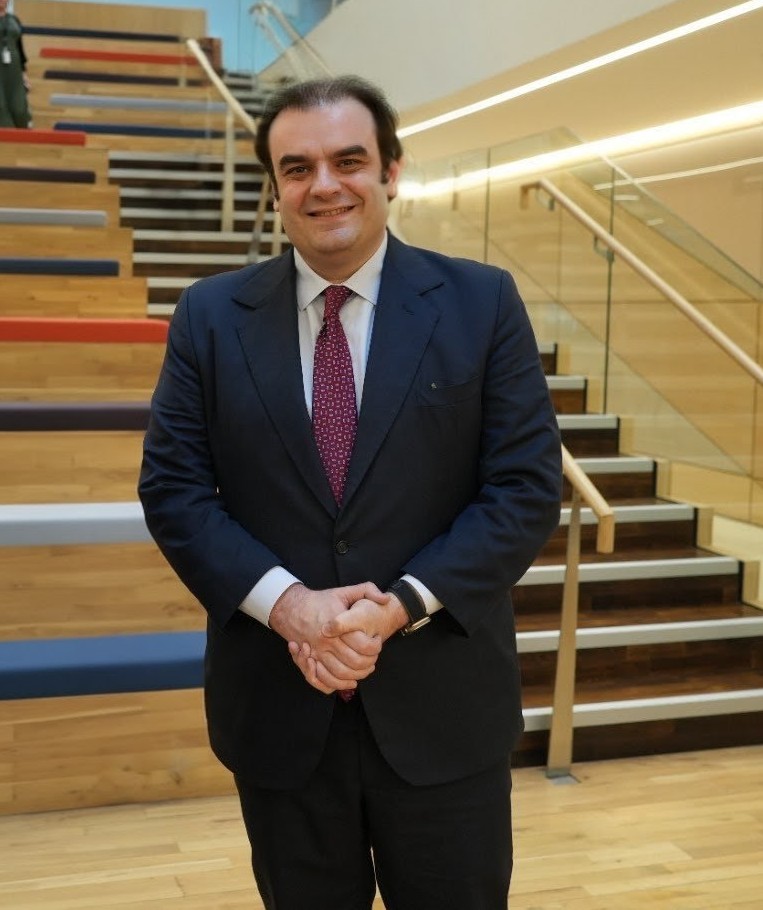
Greek Finance Minister Kyriakos Pierrakakis was elected on Thursday as the new President of the Eurogroup. His term will last two and a half years, and he assumes office on Friday.
“The Eurogroup today elected Kyriakos Pierrakakis, Minister of Economy and Finance of Greece, as President of the Eurogroup, in line with Protocol 14 of the EU treaties. The new President will take office as of 12 December 2025 and will serve a two-and-a-half-year term. The first Eurogroup meeting under Kyriakos Pierrakakis’ presidency is currently planned for 19 January 2026,” said Eurogroup’s announcement.
Mitsotakis on Pierrakakis’ election: A strong message that better days are coming
Prime Minister Kyriakos Mitsotakis, following the election of Finance Minister Kyriakos Pierrakakis to the Eurogroup presidency, said that this is a day of pride for Greece. He also underlined that it is the most emphatic recognition of Greece’s positive course.
The Greek Premier noted that this development comes “exactly a decade since the country was on the brink of collapse, with banks closed and just before the exit from the euro” and added: “Greece has demonstrated in practice that fiscal consistency is a prerequisite for improving its credibility. And, furthermore, that it can, in combination with bold reforms, keep pace with dynamic growth. Growth that creates jobs and ultimately returns a dividend to citizens.”
Concluding, Mitsotakis said that “the election of our Finance Minister to lead the Eurogroup is an important milestone on this path of progress. An event that gives the country confidence. It also arms the government with new momentum to implement its programme, with 2027 as the first milestone and 2030 as the horizon. Most importantly, it sends a strong message of optimism and national uplift that better things are coming.”
Hatzidakis hails Pierrakakis’ Eurogroup election
Deputy Prime Minister Kostis Hatzidakis congratulated Kyriakos Pierrakakis on his election as President of the Eurogroup. He said in a social media post that it was a great success for Pierrakakis, for Prime Minister Kyriakos Mitsotakis, for the Government of New Democracy, and above all for Greece.
“Pierrakakis’ election underlines that Greece, which 10 years ago was on the doorstep of leaving the euro, is today considered in Brussels an example of success. Have no doubt that if we had not pursued a serious and credible policy, we would not even have been able to stand for the Eurogroup Presidency,” said Hatzidakis and added that: “We are certainly not claiming that all problems have been solved. However, great progress has been made in our economy over the last six years, in an environment of repeated international crises. And we are determined, with systematic effort, to take Greece even higher.”
Government Spokesman Marinakis’ post on Pierrakakis’ election
Commenting on Pierrakakis’ election to the Eurogroup, government spokesman Pavlos Marinakis said that “this is a historic moment for Greece, which reflects the recognition of the country’s progress and the vindication of the sacrifices of its citizens.”
In a social media post, he noted: “From the queues at ATMs, capital controls, and closed banks, Greece, with Kyriakos Mitsotakis as Prime Minister, has not only returned but is now a leading player in the decision-making centres.” Marinakis said and added that “Today’s success is an incentive for all of us to accelerate even more our hard work to return to our citizens what they were deprived of, to give hope to our young people again, and to lift the country even higher. My friend Kyriakos, congratulations from the bottom of my heart! We are proud!”
Eurogroup President CV
The CV of the new Eurogroup President Kyriakos Pierrakakis, from the Eurogroup website is as follows:”
“Kyriakos Pierrakakis is Greece’s Minister of Economy and Finance and an elected Member of Parliament representing Athens. In his current role, he leads the country’s economic and fiscal strategy, with a focus on strengthening fiscal credibility, modernising economic governance, and improving the long-term resilience of the Greek economy. His priorities include reforming the tax system to incorporate advanced technology and to address the consequences of demographic change, strengthening medium-term fiscal planning, improving the quality of public expenditure, enhancing productivity, and attracting strategic investment. His work is closely aligned with Europe’s broader economic agenda, particularly the drive to strengthen competitiveness, deepen integration and support long-term stability in the euro area.
Previously, as Greece’s Minister of Digital Governance (2019-2023), he oversaw a nationwide transformation of public administration, creating platforms such as gov.gr, the Gov.gr Wallet, and MyHealth, and significantly expanding digital public services. These reforms ensured continuity of state operations during the COVID-19 pandemic and improved institutional capacity. His leadership in digital governance led to his appointment – and reappointment – as Chair of the OECD Global Strategy Group (2021, 2024).
As Minister of Education (2023-2025), he advanced reforms to modernise Greece’s education system, including a new legal framework for foreign universities, the establishment of national digital learning infrastructures, and policies to improve learning environments such as a nationwide smartphone restriction in schools. Earlier in his career, he served as Director of Research at the think-tank Dianeosis, working on structural reform, institutional performance, and evidence-based policymaking.
He holds a Master in Public Policy from Harvard University’s John F. Kennedy School of Government, a Master of Science in Technology and Policy from the Massachusetts Institute of Technology, and a Bachelor’s degree in Computer Science from the Athens University of Economics and Business.
He speaks English and French and is married with three children.”